The Best Tennis Betting Strategy in One Line
Bet only when your own estimate of a player’s chance is higher than the price implies, stake the same way every time, and pass on everything else. That is the best tennis betting strategy we know, and the rest of this page is detail on each part of it. It sounds dull. It is meant to. Plenty of tennis betting advice sells a shortcut, a system or a tipster, and none of them changes the arithmetic of the margin, which is where this guide starts.
After that come value and prices, the stats and ratings that move a tennis price, why fixed systems break, how to stake, especially on short favourites, and how exchange traders work a match. We finish with when not to bet at all and what all this means at the six sites we compare. If you bet in-play, our live tennis betting guide covers live markets and the delay.
How to Win Betting on Tennis Starts With the Margin
Two players, no draw, prices on every match of the day: tennis looks like the easiest sport to back. Is tennis betting profitable, then? For most people, no, and the reason is built into every price. Add up the implied chances of both players, 1 divided by each decimal price, and you get more than 100%. Price both players at 1.91 and the total is 104.7%. The 4.7% over the top is the bookmaker’s margin.
That margin is your opponent before either player hits a ball. Spread evenly, a 5.8% margin means betting at random returns about 94.5p for every pound staked. How to win betting on tennis, in practice, means finding prices where your edge is bigger than that cost. Anything that doesn’t, from a hunch to a tipster’s confidence, loses slowly.
Margins on ATP, Challenger and ITF Matches
The margin isn’t fixed: it grows as you go down the tours. These are the median match winner margins we measured, with what betting at random would return per pound if the margin were spread evenly.
| Site and tour | Date | Matches | Median margin | Returns per £1 at random |
|---|---|---|---|---|
| Odin Fortune, ATP (singles and doubles) | 6 Nov 2026 | 8 | 5.8% | 94.5p |
| Odin Fortune, WTA | 6 Nov 2026 | 14 | 6.4% | 94p |
| Odin Fortune, Challenger | 6 Nov 2026 | 25 | 8.1% | 92.5p |
| Odin Fortune, ITF | 6 Nov 2026 | 60 | 9.3% | 91.5p |
| Cosmobet, all tours | 9 Nov 2026 | 35 | 8.8% | 92p |
| BetFoxx, all tours | 11 Nov 2026 | 28 | 8.4% | 92p |
Cosmobet showed the same pattern, at 7.0% on ATP and 8.9% on Challenger. Outrights cost more again: on 9 November LegionBet’s Australian Open winner lists added up to about 174% for the men and 162% for the women.
Lower-ranked players are also harder to predict. A 2016 study by Stephanie Kovalchik, testing 11 published models on 2,395 ATP Tour singles matches from 2014, found all of them “10–20 percentage points less accurate” on matches among lower-ranked players than on matches with the top players. It didn’t cover Challenger or ITF matches, so treat it as a warning for the lower tours, not a measurement of them.
Why Every Acca Leg Adds to the Margin
Accumulators multiply the margin along with the odds. Three legs priced at a 5.8% margin carry about 18.4% between them, because 1.058 × 1.058 × 1.058 is 1.184, so a blind treble returns about 84p in the pound instead of 94.5p. On ITF legs at 9.3%, the treble returns about 77p. That matters at Zizobet and Cosmobet, whose welcome bonuses count only accas of three or more at 1.30 a leg: the bonus has to be worth more than the extra margin you take on to clear it. Our tennis bet types guide explains how acca legs settle.
Tennis Value Bets: Your Chance Against the Price
A value bet is a price bigger than the chance it implies, by your estimate. Say a player is 2.40. That implies 41.7%. If your read of the match puts them at 45%, the bet is worth about 8p per pound staked on average, because 0.45 × 2.40 is 1.08. Rate a 1.30 favourite at 75% and the bet is worth about minus 2.5p, because 1.30 implies 76.9%. The favourite will usually win. The bet still loses money over time.
That gap between a winner and a value bet is the whole game. Tennis value bets don’t mean underdogs or long shots; they mean a price you believe is wrong, for a reason the market hasn’t already priced in. The hard part is the estimate, which is what the stats, ratings and models below are for. If decimal odds and implied chance are new to you, our guide to tennis betting odds covers the basics.
Odds-On Favourites, Underdogs and Low Odds
An odds-on price is one shorter than evens, below 2.00 in decimal, so you win less than you stake. In tennis that is the normal state of things. On the morning of 5 November 2026, 101 of the 233 matches priced at Wildies had a favourite under 1.30; at Zizobet on 4 November, read from Germany, six of 12 ATP favourites in Paris were under 1.30; at Cosmobet on 9 November, read from Finland, 11 of 35 favourites were. The bookies’ favourite is expected to win most of the time, and at those prices it has to: at 1.30 it needs to win 76.9% of the time just to break even.
Low odds aren’t a strategy on their own, and neither is backing every underdog. A tennis underdog betting system that backs every outsider pays the margin on every bet, just at bigger prices. The question is the same at 1.25 and at 4.00: is the price wrong? Short favourites also fail most offers’ minimum odds, which the section on our sites comes back to.
Comparing Prices Across Betting Sites
The one edge anyone can take is the better price. Taking 2.00 instead of 1.91 pays 4.7% more on every winning bet, most of the 5.8% median ATP margin above. Prices differ more than you might expect: on 6 November 2026, Odin Fortune’s price beat Wildies’ on 83 of 100 sides across 50 singles, and on 5 November LegionBet’s beat Wildies’ on 70 of 86, read hours apart, and Zizobet’s on 13 of 16. Prices move all day, so these are snapshots, not rankings. Our comparison of tennis odds has the head-to-heads.
Tennis Betting Stats: Serve, Return and Surface
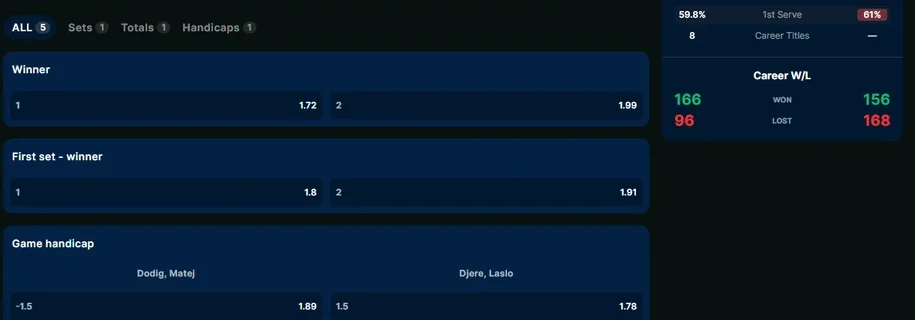
I spend much of my time on form, head-to-head records and surfaces, but the serve comes first. Tennis is a serving game, and the most useful tennis stats for betting start there: how often a player holds serve and how often they break. In the ATP’s 52-week stats, read on 11 November 2026, Jannik Sinner topped the serve leaderboard and won 93.8% of his service games, while Carlos Alcaraz topped the return leaderboard and won 29.7% of his return games. Put one player’s hold rate against the other’s break rate and you have the core of many tennis models.
The detail underneath tells you where a hold rate comes from: first-serve and second-serve points won, which the ATP’s serve leaderboard breaks down by player, and how a player serves on break points. Anyone who has competed knows a second serve under pressure tells you more than an ace count does.
Surfaces, Conditions and Indoor Events
The same player can be two different players. Tennis Abstract keeps separate Elo ratings for hard courts, clay and grass, and in its list updated on 9 November 2026 Arthur Fils was rated 1941.2 on clay and 1782.7 on grass, a gap of almost 160 points. Between two players, a gap that size makes one about a 71% favourite. Sinner and Alcaraz show the milder version: on those ratings Sinner’s edge is about 63% on hard courts but 59% on grass.
Conditions add another layer. Clay is usually described as the slower surface that favours returners, and grass and fast indoor courts as quicker ones that favour big servers; where that holds, breaks get rarer and tie-breaks more likely. Treat it as a reason to look at a price again, not as a rule: the market knows a court is fast too.
Form, Fatigue and the Schedule
Ratings change slowly; bodies don’t. A player coming off a three-hour match the night before, a long trip between continents or a run of tournaments in consecutive weeks may be priced on reputation rather than on legs. Best of five in men’s Grand Slam singles stretches that further.
A rating built on last season’s results can’t see a sore shoulder, so physical doubt is where an estimate goes wrong fastest. When a player is clearly struggling, remember what a retirement does to your bet: it depends on the bookmaker, and our tennis retirement rules guide shows each one.
Tennis Betting Models, Algorithms and Software
Every tennis betting model, from a spreadsheet to a paid algorithm, does the same job: turn information into a win chance, then compare it with the price. The simplest that works is Elo. Each player has a rating that rises after a win and falls after a loss, by more when the result is a surprise, and the win chance comes from the gap between two ratings alone. The table shows what a gap is worth in a best-of-three match.
| Elo gap | Stronger player’s chance | Fair odds |
|---|---|---|
| 0 | 50% | 2.00 |
| 50 | 57% | 1.75 |
| 100 | 64% | 1.56 |
| 150 | 70% | 1.42 |
| 200 | 76% | 1.32 |
| 300 | 85% | 1.18 |
Here it is with real numbers. In Tennis Abstract’s ratings updated on 9 November 2026, Sinner was 2296.9 and Alcaraz 2194.9, a gap of 102 points. By our arithmetic on those overall ratings, that gives Sinner about a 64% chance in a best-of-three match, fair odds of about 1.56 for him and 2.80 for Alcaraz before any margin: an illustration, not a price for any match. Tennis Abstract’s WTA Elo ratings had Elena Rybakina and Aryna Sabalenka 0.7 points apart at the top, a coin toss. The site notes that a 100-point gap means about 64% in a best-of-three match, and Jeff Sackmann, who runs it, writes that best of five needs an adjustment and that he blends surface and overall ratings 50/50.
Does it work? In Kovalchik’s 2016 comparison, an Elo model built by FiveThirtyEight was, with ranking-based models, the most accurate of the 11 tested using one year of data, and called 75% of matches among the top-ranked players, “competitive with the bookmakers”. That is the honest ceiling: a good model gets you close to the market, and an edge comes from what the model can’t see. Tennis betting software and algorithms sold online do the same job, so ask what one knows that the price doesn’t before paying for it. How to build a tennis betting model for free: record results, update ratings match by match, turn gaps into chances and compare them with prices you could really have taken. A tennis betting model in Excel can do all of it with one formula: 1 / (1 + 10^(−gap / 400)).
Tennis Betting Systems and Why Fixed Rules Break
A tennis betting system is a rule that decides your bets without looking at the price: back every underdog after a lost first set, lay every server at 15-40, double up after a loss. Systems are easy to follow, which is the point of them, and that is also the flaw. A rule that ignores the price can’t know when the price is wrong, so it pays the margin on every bet it makes.
Doubling up shows how quickly it breaks. Start with £10 at evens and double after every loss: six defeats in a row, a 1-in-64 chance even at a true 50%, cost £630 and ask for £640 to win back £10. At real tennis prices, where an evenly matched pair might both be 1.91, that £640 bet wins £582.40 and doesn’t even cover the run. Systems come back in new clothes every season. The best tennis betting system is still the one with value on its side, and no fixed rule can promise that.
Staking Plans for Tennis Bets
Staking decides how long you last, not whether you win. Level stakes, the same amount on every bet, are the simplest plan and the easiest to keep to. Percentage stakes, a fixed share of your betting bank such as 1% or 2%, shrink after losses and grow after wins. The Kelly criterion, named after J. L. Kelly’s 1956 paper, sizes each bet by your edge: the stake fraction is (b × p − q) ÷ b, where b is the decimal odds minus 1, p your estimated chance and q is 1 − p.
On the 2.40 example above, with a 45% estimate, Kelly says 5.7% of the bank, £28.57 from £500. Many who use it stake half Kelly or less, because Kelly assumes your estimate is right, and an estimate never is exactly. Whatever the plan, set your budget first and keep it apart from everything else; our responsible gambling guide has the tools.
The Best Staking Plan for Low Odds
Short prices change the arithmetic. To win £10 at 1.30 you stake £33.33, so one loss wipes out more than three wins, and the favourite has to win 76.9% of the time just to break even. At 1.50 you stake £20 and need 66.7%. Kelly shows how fragile that is: at 1.30, an 80% estimate says stake 13.3% of your bank, 77% says 0.3%, and 75% says don’t bet at all.
So the best staking plan for low odds is a small, level one: the same modest stake on every short-priced bet you take, and fewer of them. The best staking plan for 1.5 odds is no different. Raising stakes to make short prices pay is how a run of winners ends in one bad afternoon.
Tennis Trading on the Betting Exchanges
Tennis trading means betting on an exchange with a plan to close the position before the match ends: backing a player and later laying them, or the reverse, to lock in a profit or cut a loss whichever way it finishes. Tennis suits it because prices swing hard at breaks of serve and set points. Betfair tennis trading works the same way as trading on Smarkets or Matchbook, which run tennis markets too.
Two things catch traders out. The first is a retirement: the exchanges settle one after the first set as a win for the player who goes through, while some bookmakers void the match, so a back at one and a lay at the other can leave you exposed, as our tennis retirement rules guide explains. The second is the delay: Betfair itself warns that other customers may have faster, more accurate data than its own site shows. If you try a tennis trading course or software, practise with small stakes first.
Back-to-Lay and Hedging Through a Match
Here is how to trade tennis in its simplest form. You back a player at 3.00 for £10 before the match. They win the first set and their price falls to 1.80. To lock in a profit, you lay them at 1.80 for £16.67, which is £10 × 3.00 ÷ 1.80. If they win, the back pays £20 and the lay costs £13.33; if they lose, the back loses £10 and the lay wins £16.67. Either way you are about £6.67 up before commission, or about £6.53 after 2%.
Hedging works the same way in reverse, to cut a loss when your player falls a break behind. The 15-40 tennis trading strategies you’ll read about are timing rules around break points, when prices often move most. Low risk tennis trading still carries risk: the price you want may be gone by the time your bet reaches the exchange.
Betting Exchanges for Tennis Trading: Commission Compared
On an exchange the cost is commission, not a margin built into the price. Smarkets’ help centre, read on 11 November 2026, puts its Standard Tier at “2% on net profits per market”; traders with more than 1,500 bets or £1m staked in a month must opt in to a 1% Pro Tier, and a 3% Select Tier applies to the few with over £25,000 net profit in 12 months; both are charged on each settled bet, win or lose. Betfair Exchange charges only on net winnings in a market, at a Market Base Rate that depends on where you live, unless you’ve chosen a My Betfair Rewards package, reduced by a discount based on Betfair Points: net winnings × Market Base Rate × (100% − Discount Rate).
Check the rate on your own account and put it in every sum: 2% is small next to a bookmaker’s margin, but a trader pays it on every winning market. We couldn’t read Matchbook’s commission page on 11 November, so its rate isn’t listed. Betfair Exchange, Smarkets and Matchbook are the three betting exchanges whose tennis rules we have read, and all three are lay betting websites, where you can bet against a player as well as for one.
When Not to Bet on a Tennis Match
Most of tennis betting strategy is saying no. Pass when you can’t say why the price is wrong. Pass when the doubt is about a player’s fitness rather than their form, because a retirement can void, pay or lose your bet depending on the bookmaker. Pass on ITF and UTR matches you know little about; ITF carried the highest margins we measured. Pass on simulated matches too: Zizobet and Cosmobet list Simulated Reality events beside real ones, and no stat or rating tells you anything about them.
And pass when the bet is really about the last one. Chasing a loss into the next match, or the next set, is one of the most expensive habits in tennis betting, because the schedule never stops: there is always another match starting somewhere. Set a budget and a time limit before you start, and if betting stops being fun, our responsible gambling guide has help and tools.
Tennis Betting Strategy at the Sites We Compare
The six sites we compare are bookmakers, not exchanges, so trading is out and price is everything. Their offers bend a strategy more than anything else. On the terms in our reviews, read between 28 October and 9 November 2026, Zizobet and Cosmobet count only accas of three or more selections at 1.30 a leg towards their 15× wagering, which pushes you into exactly the multiplied margin above. Wildies needs 1.80 on a single, Odin Fortune 1.75 and LegionBet’s qualifying bet 1.50, all above most favourites’ prices, while BetFoxx sets no minimum odds. Our offers comparison shows which tennis bets count at each.
Their lists lean towards the lower tours, where the margins we measured were highest: 237 of the 418 tennis events on Zizobet’s list, read from Germany on 4 November, were ITF matches. None of the six holds a UK licence, and a disputed bet goes to the site first, then to a dispute service such as eCOGRA if it uses one. Each review has the margins, prices and terms in full: Zizobet, Cosmobet, LegionBet, Odin Fortune, Wildies and BetFoxx.
Sources: the Data Behind This Guide
We name our sources rather than link them. Prices, margins and offer terms come from our own reads for the reviews; the rest is below, with the date we read it.
| Source | What we used | Read |
|---|---|---|
| Tennis Abstract | ATP and WTA Elo ratings, overall and by surface, updated 9 Nov 2026 | 11 Nov 2026 |
| Jeff Sackmann, Tennis Abstract | “An Introduction to Tennis Elo”, 3 Dec 2019 | 11 Nov 2026 |
| Stephanie Ann Kovalchik | “Searching for the GOAT of tennis win prediction”, Journal of Quantitative Analysis in Sports, 2016 (abstract) | 11 Nov 2026 |
| ATP Tour | Serve and return leaderboards, last 52 weeks | 11 Nov 2026, from Finland |
| Betfair Exchange | Help: “What is Commission and how is it calculated?” | 11 Nov 2026, from Finland |
| Smarkets | Help centre: “Smarkets commission FAQ” | 11 Nov 2026, from Finland |
| Our reviews and Australian Open page | Margins, prices, short favourites, outright totals and offer terms | 28 Oct to 11 Nov 2026 |
Tennis Betting Strategy FAQ
What is the best tennis betting strategy?
Bet only when your estimate of a player’s chance is higher than the chance the price implies, keep your stakes small and level, and skip matches where you have no reason to think the price is wrong. No system or tipster changes the margin, which at Odin Fortune on 6 November 2026 ran from a median 5.8% on ATP matches to 9.3% on ITF.
Is tennis betting profitable?
For most bettors, no. Every price carries a margin, so betting at random returns less than you stake: about 94.5p in the pound at a 5.8% margin. Profit needs prices that are better than the real chance, again and again, and the discipline to pass on everything else.
What is a value bet in tennis?
A bet whose price implies a lower chance than you think the player really has. A player at 2.40 implies 41.7%; if you rate them at 45%, the bet is worth about 8p per pound on average, even though they will lose more often than they win.
Do tennis betting systems work?
Fixed systems don’t, because they ignore the price and pay the margin on every bet. Doubling up after losses is the clearest case: from a £10 start, six defeats in a row cost £630 and need a £640 stake to win back £10.
How much should I stake on a tennis bet?
A small stake from a budget you set in advance, either level or 1% to 2% of a betting bank. Kelly staking sizes bets by your edge, but it trusts your estimate completely, so many who use it stake half Kelly or less. At short odds keep stakes small: at 1.30 you stake £33.33 to win £10.
What is tennis trading?
Betting on an exchange with a plan to close the position before the match ends, by backing and then laying a player, or the reverse, as the price moves. It can lock in a profit or cut a loss whatever the result, but every winning market pays commission, 2% at Smarkets’ standard tier, and retirements and data delays can catch you out.

Quick set · free tennis game
Fancy a break?
Play one game of tennis against the computer, with real scoring: deuce, advantage and all.
Play a game